

Tuindorp Vooruit (former Enka-dorp)
Ede, Netherlands
A garden district built for the employees of the ENKA artificial silk factory in Ede.
| Garden City Type: | Former company town |
| Country: | Netherlands |
| City: | Ede |
| Years of construction: |
The garden village was built in two phases. The first phase was completed in 1922. The second phase consisted of 140 homes. 1921 Start construction 1925 Completion
|
| Initiator/client: | Woningbouwvereniging "Vooruit"/ENKA Kunstzijdefabriek |
| Architect or related: |
F.A. Eschauzier Frits Adolf Eschauzier (The Hague, 1889 - 's-Graveland, 1957) was a Dutch architect. P.J.W.J. van der Burgh Petrus Johannes Wilhelmus Jacobus van der Burgh (Berkel en Rodenrijs, March 29, 1872 - Saint Raphael, France, January 24, 1963) was a Dutch architect. |


| Heritage status: | Yes |
| Explanation: | Part of Phase 1 is a municipal monument. |
| General condition of Garden City: | Recently renovated |
General description
The garden village was built for employees of artificial silk factory ENKA in Ede, which opened in Ede in 1922. ENKA founded Woningbouwvereniging Vooruit ('Housing Association Forwards') for this purpose, partly also to reduce travel time for the personnel. The district came about in two phases and included social and cultural facilities for the staff, such as schools, associations, a cultural center and a swimming pool.
The first phase - 159 dwellings and 2 stores on Blokkenweg, Zijdelaan, Twijnstraat and Kerkweg - was completed in 1922. The second phase consisted of 140 dwellings on Blotenberglaan, Kempjeslaan, Nijverheidslaan, Graafhoek, Kortelaantje, Poortplein and Kerkweg. The semicircular Poortplein, which includes a bandstand, schoolhouse and stores, forms the central space in Tuindorp.
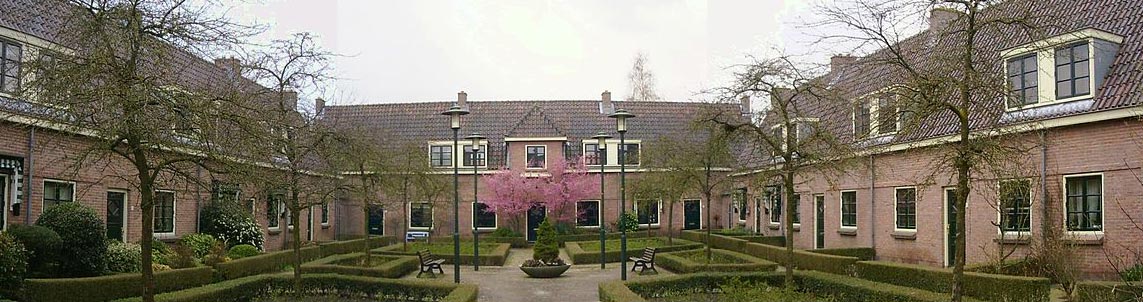 Courtyard at Poortlaan (Pim van Tend / Wikimedia Commons, 2014).
Architecture / Urban planning
Most buildings had two stories and a hipped or gabled roof. The use of materials was traditional with dark red facades, brickwork and roofs covered with tiles. Most homes were wider than they were deep. Many homes had a bathroom and bedroom on the first floor, with a few more sleeping quarters upstairs.
At Parkweg en het Poortplein, gatehouses mark the entrances to the complex. Seclusion is characteristic of the buildings between Poortplein and Zijdelaan. Here the building blocks are close together. The courtyard on Poortlaan occupies a special place within the urban planning structure.
Greenery played an important role in the design of the neighbourhood, with attention to courtyards, gardens and public green spaces. The gardens allowed people to grow vegetables and raise chickens.
Recent developments
The first phase was renovated (completed in 1997). This involved changing the layout of the houses. The surroundings of the houses were also returned to the original situation as much as possible. The homes of the second phase were replaced with new construction from 1995 to 2003.
Sources
- Website URL
The rich history of Tuindorp Vooruit [in Dutch]
- Website URL
Vereniging Oud Ede: Tuindorp Vooruit [in Dutch]